AI Factory
Flagship · A deterministic orchestration engine that turns a project description into working software.
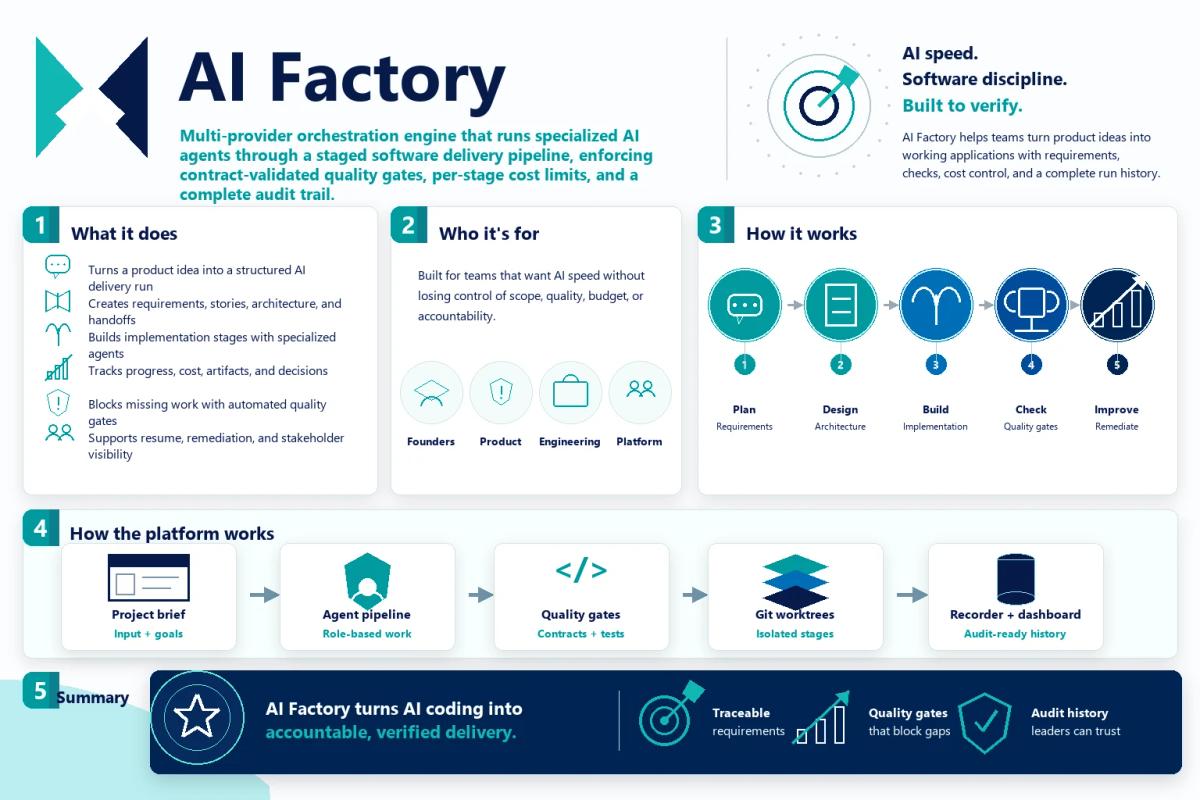
AI Factory turns AI-assisted software development from a single sprawling chat session into a structured, gated, auditable pipeline where nothing gets silently dropped.
The Problem
Everyone has had the same experience. You describe what you want to an AI, it produces something impressive, and then you spend the next three days finding out what it quietly left out. Requirements evaporate between the idea and the code. Tests get written to pass rather than to prove. There is no record of what the model was told, what it decided, or why.
The failure is not intelligence. It is process. One session trying to be analyst, PM, architect, and developer at once has no checkpoint where anything is verified against what was actually asked for.
The System
AI Factory runs a team of seven specialized AI agents through a defined software development lifecycle. The analyst explores the problem and produces a product brief. The PM writes a PRD with traceable requirements. The architect designs the system and produces test contracts before a line of code exists. The developer implements inside isolated git worktrees using test-driven development. A scrum master collaborator keeps every stage honest.
The part that matters: every stage output is validated against a machine-enforced contract before the pipeline is allowed to advance. Not a model grading its own homework. Schema validation, completeness checks, upstream reference checks, traceability coverage, static analysis, mock detection: sixteen check types in total. If a gate fails, the system retries, escalates to a more capable model, or routes the problem back to the upstream agent that caused it. A run literally cannot complete with a must-have requirement missing.
How a Run Flows
Point AI Factory at a project directory, describe what you want, and run one command. Content-based cache keys skip stages whose inputs have not changed. Checkpoints mean a crash or a pause resumes where it stopped. An event store records the whole run as a queryable audit trail rather than a chat log you scroll. When gaps do turn up, the remediate command generates targeted fix stages: three missing components get three fixes, not a full rebuild. The engine drives multiple providers with per-agent model selection and no vendor lock-in baked into the core.
Why It Matters
AI Factory is not an AI wrapper and it is not a chatbot. It is a deterministic orchestration engine that happens to use AI agents as its execution units, the same way a CI/CD system uses shell commands. The industry has spent two years making models better at generating code and almost no time making the process around them accountable. AI Factory is a bet that the second problem is the one actually blocking serious adoption.
For a solo builder, it is leverage: one operator running a full team's worth of structured work with a paper trail. For an engineering organization, it is the missing piece between "our developers use AI" and "we can explain, reproduce, and defend what the AI produced."
Who It Serves
Solo builders and small teams who want output beyond their headcount. Engineering leads who need AI-generated work to survive code review. Anyone who has to answer "why does the product do this?" and would like a better answer than "the model decided to."
Ready to get your AI into production?
Book a 30-minute conversation to discuss your AI goals. No pressure, no commitment: just a conversation about what's possible.